Single sourcing chemicals: making it a decision, not a default

Dual sourcing in the chemicals category has shifted from being what was considered a best practice pre-pandemic to now being a baseline expectation. For most procurement teams managing raw materials, qualifying at least two suppliers for critical inputs is now written into category strategies, risk frameworks, and supplier policies as standard.
The mandate is clear: but the commercial and operational reality can often be more complex. For a meaningful share of chemical categories, the landscape shows that single sourcing remains not just defensible but also often rational.
This article gives Global Category Leads, Strategic Sourcing Managers and Procurement Directors a framework for deciding when single sourcing still holds up, versus when the risks genuinely tip the balance.
Single Sourcing vs Sole Sourcing: Know the Difference
These terms get used interchangeably across procurement teams, but they shouldn’t. The risk profile, your negotiating position, and your contingency options are completely different depending on which of these situations you find yourself in.
Single sourcing is a deliberate strategic choice. You select one supplier for a specific material, even though you’re aware that possible alternatives exist. You could use other sources. For operational, commercial, or strategic reasons, you’ve collectively decided as an organization not to.
Sole sourcing on the other hand is a constraint, not a choice. Only one supplier can provide what you need, typically because of a patent, a proprietary synthesis route, or regulatory exclusivity. You have no possible exit ramp if this supplier fails to supply quality product, on-time in full (OTIF).
Why the distinction matters for risk management
Single sourcing is a position you can exit with planning, investment, and organizational alignment to qualify alternative suppliers. Sole sourcing is a constraint you have to manage long-term.
Confusing the two leads to poor contingency planning, and to procurement teams believing they have options they don’t actually have.
Using the Kraljic Matrix to Categorize Your Chemical Portfolio
Before deciding on a sourcing model for any chemical, you need to understand what kind of material you’re dealing with. A perfect place to start is the classic procurement textbook model: the Kraljic Matrix.
Developed by Peter Kraljic, it was published in a Harvard Business Review paper entitled Purchasing Must Become Supply Management back in 1983. Yes, we’ve been talking about this topic for over 40 years!
The matrix is the standard framework for segmenting a procurement portfolio. It maps every category across two dimensions:
- Profit impact (how much this material affects your bottom line, product quality, and customer outcomes)
- Supply risk (how difficult it is to source, driven by scarcity, supplier concentration, and geopolitical or regulatory exposure).
The result is four quadrants, each demanding a different sourcing strategy.
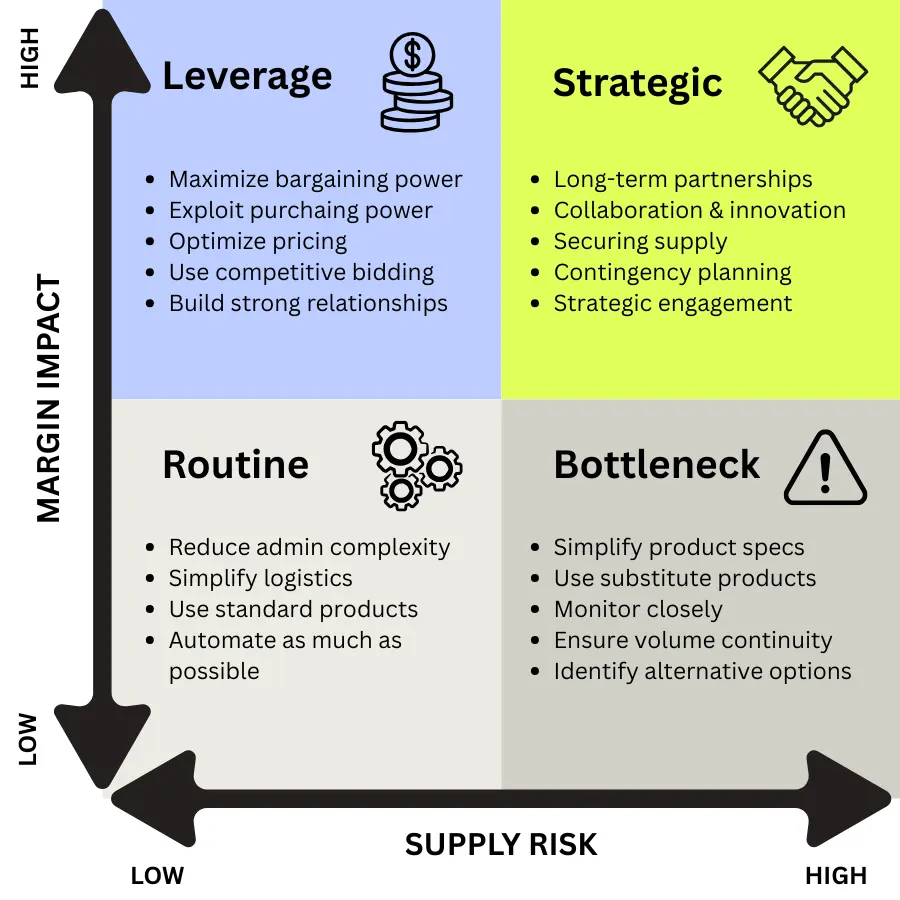
How to use the matrix to decide your sourcing model
Why chemical categories don’t stay in one quadrant
The matrix is not a one-time exercise.
Chemical categories migrate. A specialty polymer in the Strategic quadrant today may shift to Leverage in three years as patents expire and new producers enter the market. A commodity solvent can become a Bottleneck overnight following a plant shutdown in a concentrated supply region or a regulatory change in a key production country.
Treating the matrix as a live tool, revisited at least annually, is what separates reactive sourcing teams from strategic ones.
The Legitimate Case for Single Sourcing
The default narrative around single sourcing is that it’s a risk to be eliminated. That’s an oversimplification. There are clear, legitimate commercial and operational reasons why single sourcing remains the right call for certain chemical categories.
Patented and proprietary materials with no equivalent alternative
When a supplier holds a composition-of-matter patent or a unique synthesis process, alternatives either don’t exist or can’t be qualified without infringing intellectual property. In these situations,sole sourcingis the only commercially viable path. The decision shifts from “should I single source?” to “how do I manage dependency on a sole source as best I can?”
When supplier validation costs outweigh the risk
Qualifying a secondary supplier is not cheap.In regulated sectors, validation activities can consume between 4% and 8% of total project cost.For lower-criticality materials with a stable supply market, the cost of qualifying and maintaining a second source can simply outweigh the risk reduction it delivers. This is a financial calculation, not a shortcut.
Volume concentration as a competitive advantage
Consolidating spend with a single suppliercancreate real leverage, but only under a collaborative partnership with a supplier. Better unit pricing, priority allocation during periods of market tightness, dedicated technical support, and genuine opportunities for joint product development are all possible benefits. For strategic chemicals in particular, being a significant customer to one supplier often delivers more value than being a minor account with two.
When process consistency demands it
In formulation-sensitive manufacturing, including pharmaceutical batch production, specialty coatings, and CPG formulations, batch-to-batch variation matters. Switching between two suppliers, even with identical specifications on paper, introduces variables that can compromise product quality and trigger costly requalification exercises. For these categories, single sourcing often drives the lowest total cost of operation (TCO), all factors considered.
The hidden complexity of managing multiple sources
Dual sourcing carries its own operational burden that often goes unacknowledged. Running two sources for the same material means managing split inventory across two specifications, maintaining two sets of Certificates of Analysis and quality protocols, and sustaining commercial relationships with two suppliers who both know they’re sharing your volume. For categories where batch consistency is critical, or where volumes are modest, the management overhead of a dual source strategy can realistically outweigh the risk reduction it was designed to deliver.
The Real Cost of Single Sourcing Gone Wrong
The affirmative case for single sourcing is real, but then, so are the risks. And it’s worth being precise about what that downsideactually looks likein financial terms.
What unplanned production downtime actually costs
Supply chain disruptions caused by a single source failure reverberate far beyond the procurement department. They hit the production floor immediately, and the costs escalate fast from there.
According to Siemens’ 2024 True Cost of Downtime report, unplanned downtime costs the world’s 500 largest companies $1.4 trillion annually, equivalent to 11% of total revenues. The sector-level figures are stark:
These figures only cover the direct costs.
But what about the hidden costs, including idle labor, emergency parts procurement at premium prices and express logistics costs, overtime payments to catch back on lost production, as well as contractual delivery penalties to end customers? This can typically add another 2 to 3 times the visible damage.
From downtime to consequential loss
Downtime is the immediate impact. The downstream consequences are what escalate this from a supply chain issue to a board-level event.
Within days, a material shortage can move from a procurement problem to a P&L event. That is the conversation procurement leaders need to be having with their CFO and CEO, not just their category teams. The risk is not operational in isolation. It is financial, reputational, and strategic.
Building a Defensible Single Sourcing Policy
Having a framework for individual sourcing decisions is necessary but not sufficient. Procurement leaders need a policy that makes single sourcing a deliberate, documented, and periodically reviewed decision, not a habit that the organization naturally defaults to.
Map your chemical portfolio against supply risk and spend impact
Start with a Kraljic-based segmentation of your full chemical portfolio. Not every material deserves the same level of scrutiny. A clear portfolio map surfaces where single sourcing is commercially defensible, where it requires active risk management, and where it represents an unacceptable exposure that needs to be addressed.
Document the justification: make it a decision, not a default
Every chemical category operating on a single source model should have a written rationale on file.
That rationale should cover:
- Why alternative suppliers were not qualified
- What the contingency plan is if the primary source fails
- When the decision will be formally reviewed.
If a category team cannot articulate a clear justification other than “we’ve always used this supplier and never had a problem”, that is a clear red flag. This logic should be questioned using Kraljic, and evaluating the potential cost of downtime vs. the financial impact of qualifying a second source.
Identify qualified alternatives before you need them
Maintaining a shortlist of pre-qualified secondary suppliers, even if you never place an order with them, dramatically reduces response time when a disruption hits. The cost of identifying and partially qualifying an alternative supplier during stable market conditions is a fraction of the cost of emergency qualification during a supply crisis.
Conclusion
Single sourcing will never disappear from chemical procurement. For patented materials, formulation-sensitive processes, and categories where validation economics don’t stack up, it remains the right call. The goal is not to eliminate it but to make it a conscious, documented, and actively managed decision rather than a default that nobody questions until something goes wrong.
Valdera’s AI-powered sourcing platform is built specifically for the challenge of finding, evaluating, and qualifying alternative chemical suppliers. Our goal is to give chemical procurement teams the supplier discovery, market intelligence, and qualification support they need to make better sourcing decisions, faster.